Welcome to thegreatbeyond.in
Welcome to thegreatbeyond.in

upcoming cosmic events 2026

Celestrial events in the skies - 2026
🌌 What’s happening in the sky? Explore all the exciting celestial events of 2026 with The Great Beyond — from meteor showers and eclipses to planetary encounters, full moons and deep-sky wonders. 🔭 Our Upcoming Astro Events page is regularly updated so you can always find out what’s happening now, what you may have missed, and what’s coming next. ✨ Simply scroll through the sections to explore current, past and future sky events, along with useful viewing tips and information.
📅 Plan your nights, step outside, look up, and discover something amazing happening above you.
perseids meteor shower: AUG 2026
The Perseids are one of the most spectacular meteor showers visible from Earth, returning every year in July and August. They are created when Earth passes through the trail of dust and debris left behind by Comet 109P/Swift–Tuttle.As these tiny particles enter Earth's atmosphere at incredible speeds, they heat up and glow, creating the beautiful streaks of light we call meteors.
The Perseids are famous for producing bright, fast meteors and occasional spectacular fireballs. The meteors appear to originate from the constellation Perseus, giving the shower its name. You don't need a telescope or binoculars to enjoy the Perseids — your eyes are the best equipment! For the best experience, find a location away from city lights with a wide, unobstructed view of the sky. Allow your eyes around 20–30 minutes to adjust to the darkness. The best time to watch is generally after midnight and before dawn.
Lie back, get comfortable and simply scan a large area of the sky rather than looking in one particular direction. Be patient — meteors don't appear continuously, and the next bright streak could appear anywhere at any moment.
Under dark skies, you may see many meteors during the peak period. The Moon, weather and light pollution can greatly affect how many meteors are visible. The Perseids are also a fantastic opportunity for astrophotography.
A camera, wide-angle lens, tripod and long exposure can capture both meteors and the surrounding night sky. Every meteor you see is a tiny piece of an ancient comet burning up high above Earth. It is a beautiful reminder that our planet is constantly travelling through space.
Whether you're an experienced astronomer or simply curious about the universe, the Perseids are a wonderful celestial event to experience. So step outside, leave the city lights behind and give yourself a few quiet moments under the stars.
🌌 Look up, stay curious, and let the universe put on its own spectacular fireworks show!
The Great Beyond — Explore • Learn • Inspire.

Total Solar eclipse: AUG 2026
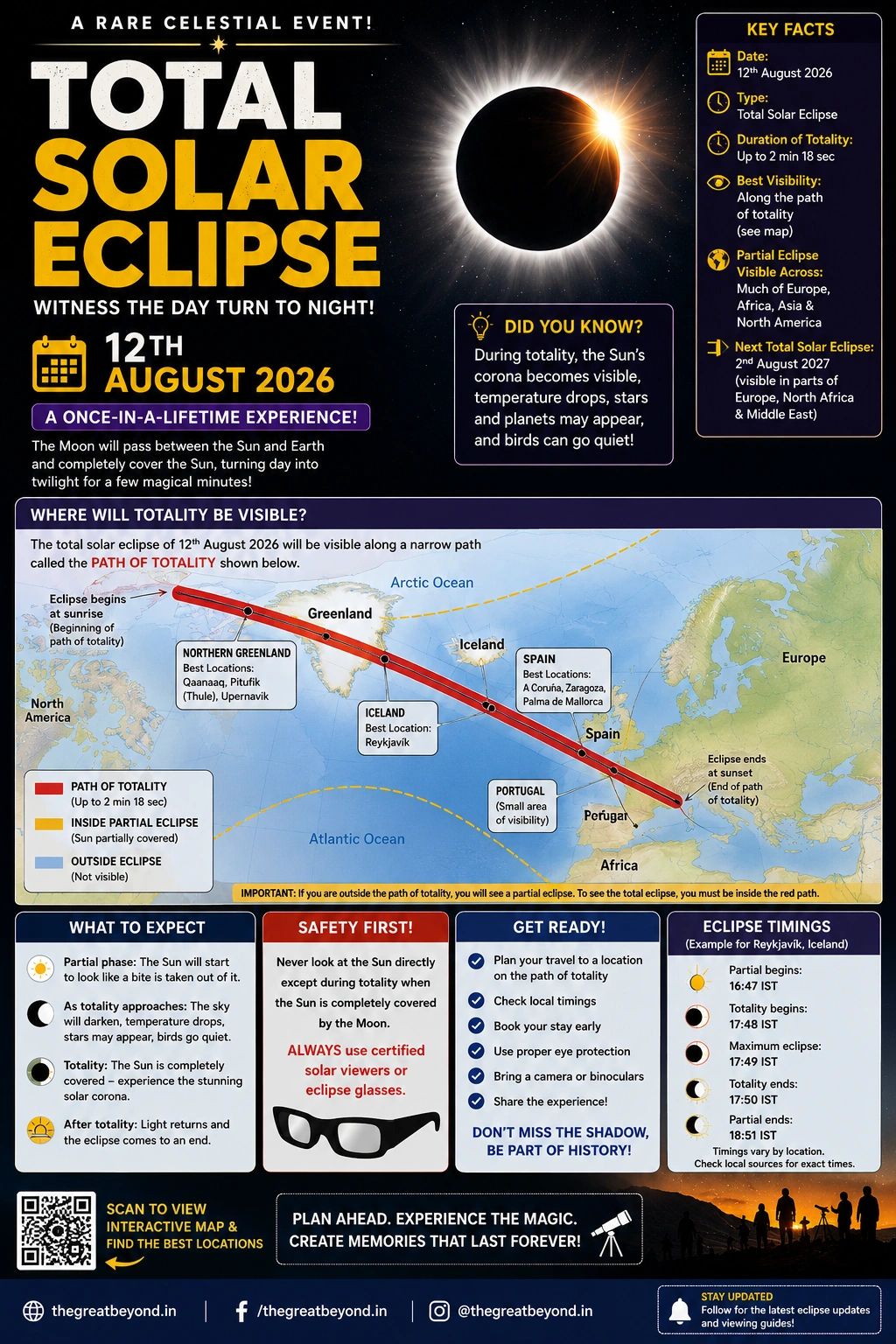
August 2026, the skies will witness one of nature’s most spectacular events — a Total Solar Eclipse. A total solar eclipse occurs when the Moon passes directly between the Sun and Earth.
The Moon completely covers the bright face of the Sun, briefly turning day into darkness.
During totality, the beautiful outer atmosphere of the Sun, called the corona, becomes visible.
This is normally hidden by the overwhelming brightness of the Sun.
The eclipse will sweep across a narrow path stretching from northern Russia across Greenland and Iceland. The path will then cross the Atlantic Ocean before reaching northern Spain and a small part of Portugal. Only observers inside this narrow Path of Totality will experience a total eclipse. Outside this path, observers may see only a partial solar eclipse, depending on their location. The maximum duration of totality will be about 2 minutes 18 seconds.
For most locations, however, totality will last less than two minutes. As the Moon gradually covers the Sun, daylight will begin to fade and the sky will darken.Temperatures may drop, shadows can become unusual, and the surroundings may suddenly feel strangely quiet.
During totality, the black silhouette of the Moon will be surrounded by the glowing solar corona. Bright stars and planets may also become visible in the darkened daytime sky. The experience can be dramatic, peaceful and completely unforgettable. Unfortunately, this eclipse will NOT be visible from Bengaluru or most of India. Bengaluru lies outside the visibility region of the 12 August 2026 eclipse.
If you want to experience totality, you will need to travel to a location within the narrow path.
Iceland and northern Spain are among the most accessible destinations for eclipse watchers.
For example, Reykjavík will experience totality in the late afternoon. In Spain, locations such as León, Zaragoza and Valencia will experience totality close to sunset. Remember: during the partial phases, never look directly at the Sun without certified solar eye protection. Only during the brief period of complete totality is it safe to look at the eclipse without eye protection.
So, 12 August 2026 is a date worth remembering — the Moon will briefly take the Sun away and reveal the magnificent corona of our star! 🌞🌑✨
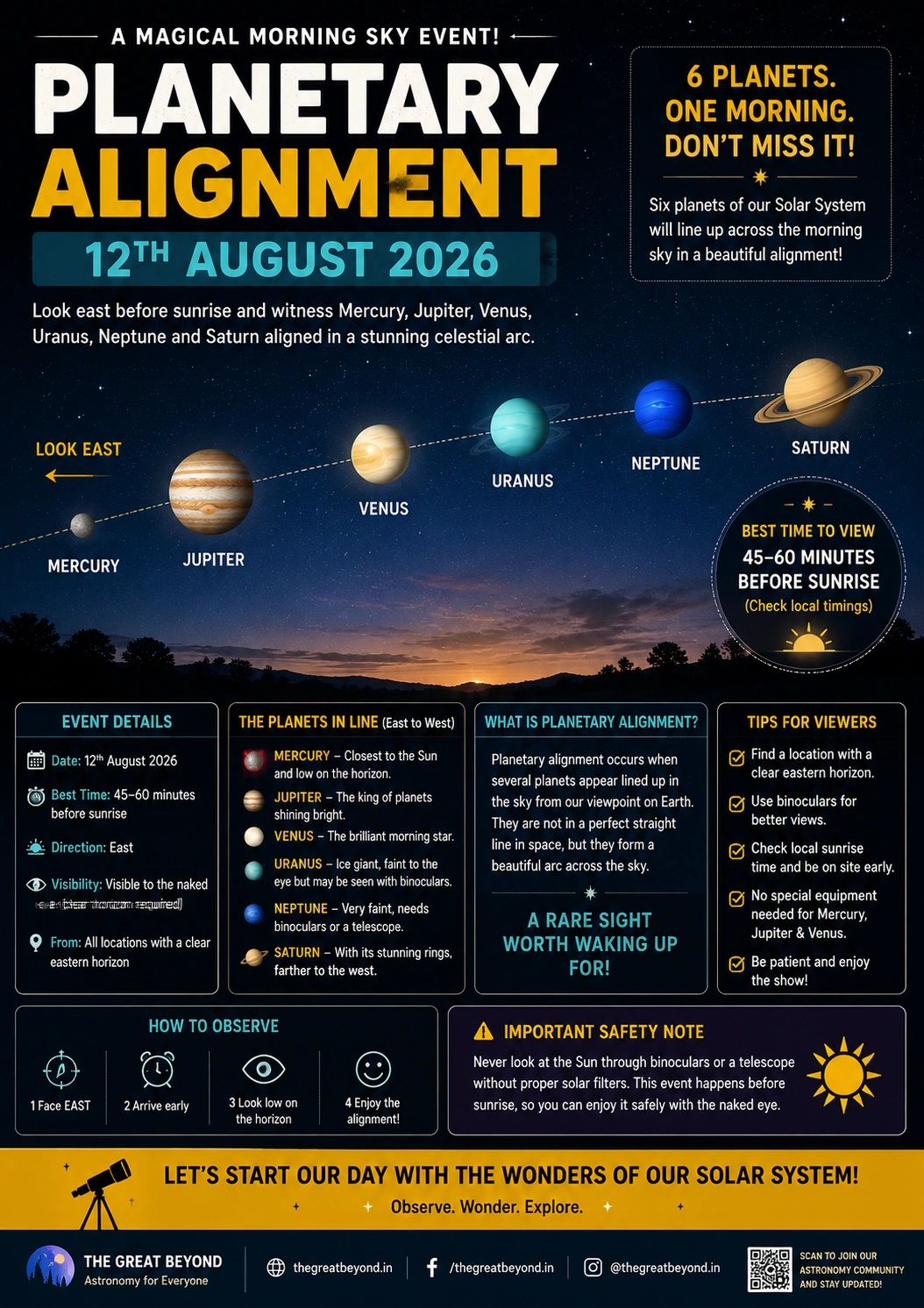
Planetary Alignment: 12 Aug 2026
On 12 August 2026, the morning sky will host a spectacular six-planet parade. Six planets — Mercury, Jupiter, Mars, Saturn, Uranus and Neptune — will appear across the sky before sunrise.
From Earth, they will appear to lie along the same broad region of the sky, close to the ecliptic.
It is important to remember that the planets are not actually lined up in a straight line in space.
This is a beautiful line-of-sight effect created by our view from Earth. The planetary parade will stretch across a large part of the pre-dawn sky. Start observing before sunrise and find a location with a wide, unobstructed horizon. Look towards the eastern sky and follow the planets along the ecliptic.
Mercury and Jupiter will be very low near the horizon and may be challenging to spot. Mars and Saturn will be among the easier planets to identify. Uranus will be much fainter and is best observed with binoculars or a telescope. Neptune is even fainter and requires a telescope to see clearly. The exact visibility will depend on your location, local sunrise time, weather and horizon.
For observers in Bengaluru, the low altitude of Mercury and Jupiter may make them particularly difficult to see. A clear eastern horizon is therefore extremely important for this event. This is a wonderful opportunity to introduce children and families to the scale and movement of our Solar System. The planets may look close together in the sky, but they are actually separated by enormous distances in space. This planetary parade is also part of an extraordinary day in astronomy, with a total solar eclipse occurring later on 12 August. The Perseid meteor shower also reaches its peak around this date, making August 12 an especially exciting day for skywatchers.
So wake up early, look east, and join The Great Beyond as we explore this spectacular morning parade of planets! 🌅🪐✨